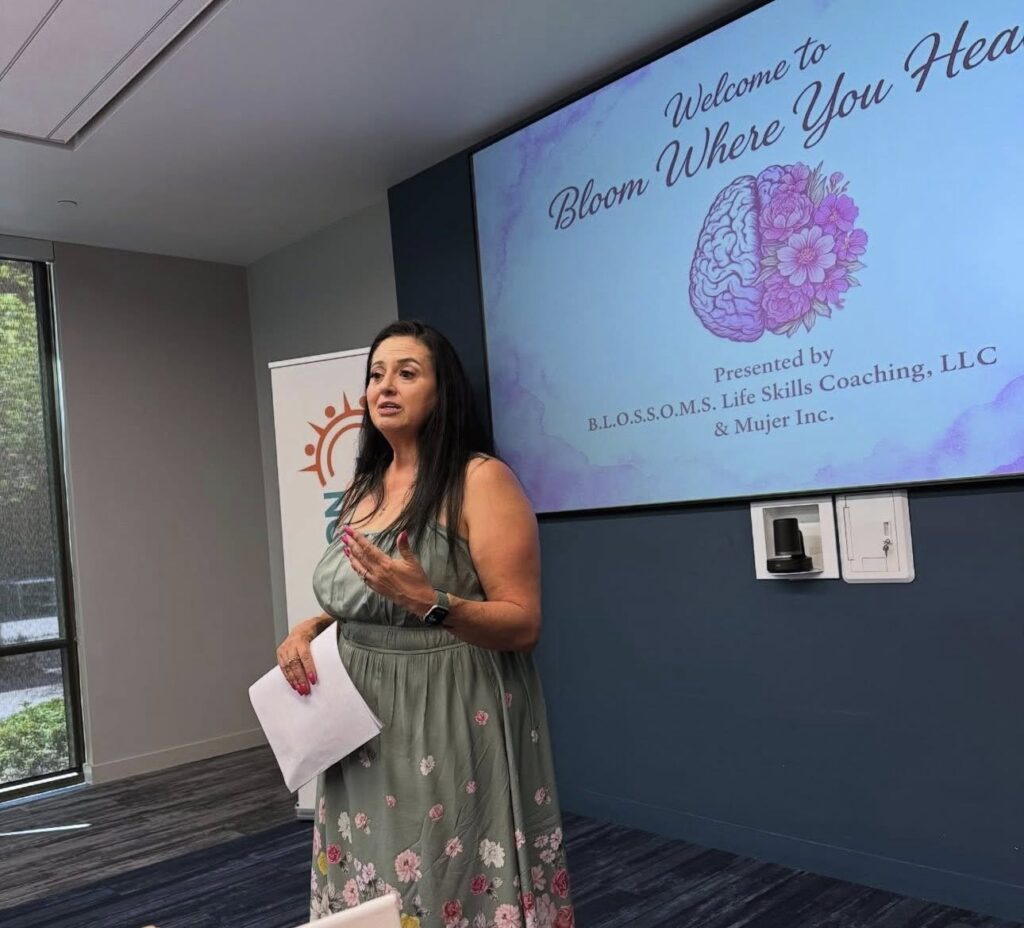
Cecilia Quiroz knows the importance of healing–both personally and professionally. With two decades of experience teaching psychology and criminal justice at Maricopa Community Colleges and helping students navigate unjust situations on campus, she has built her life’s work around resilience.
Now, through her initiative B.L.O.S.S.O.M.S. (Believe, Live. Overcome. Survive. Struggles. Observe. Motivation. Strength), she’s creating spaces where Chicanos, Latinos, and Latinx can heal using art therapy, psychology, and cultura—infused with music, love, affirmations, and acceptance.
A healing space with brushes, paint, and affirmations
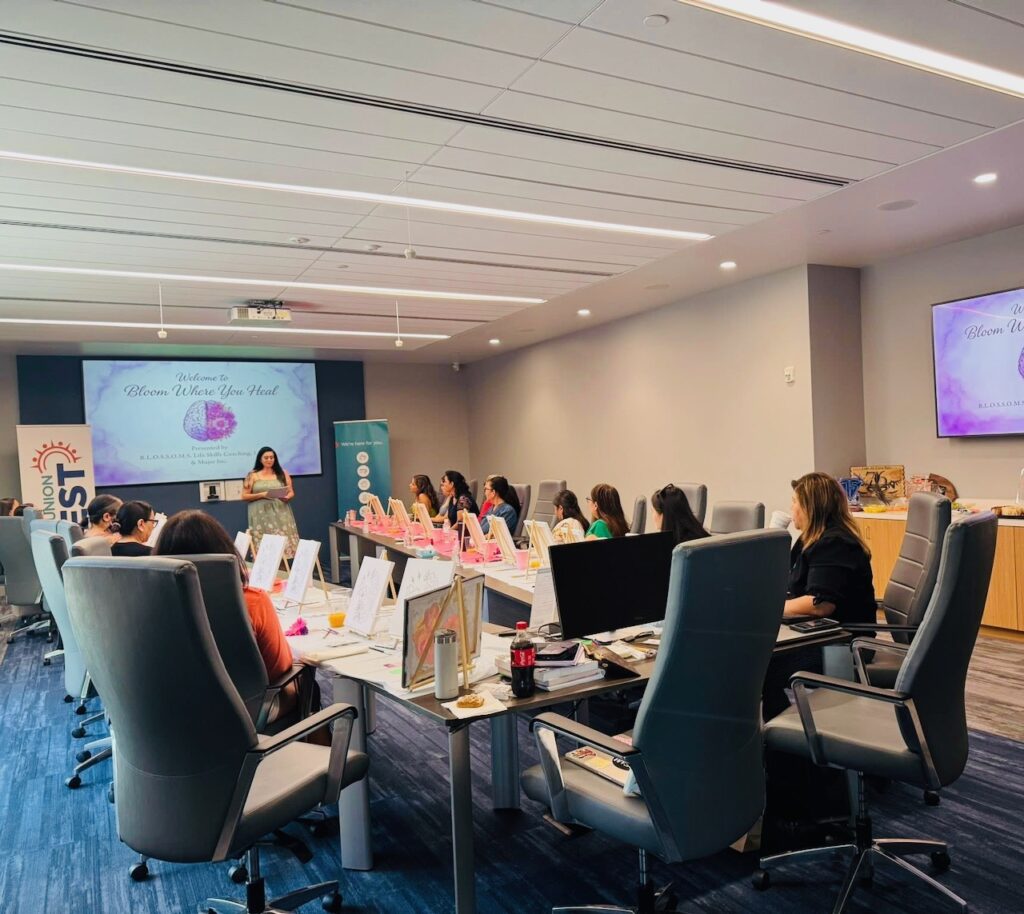
“There’s a brush and canvas. And for affirmation, if you would like to participate, place a hand over your heart or over your belly,” instructs Quiroz to a room of approximately 20 attendees at a recent Bloom Where You Heal event, presented by Mujer, Inc. in the West Valley.
“I want you to say this softly to yourself, or you can say it in your mind. ‘I am safe. I am present. I am healing.’”
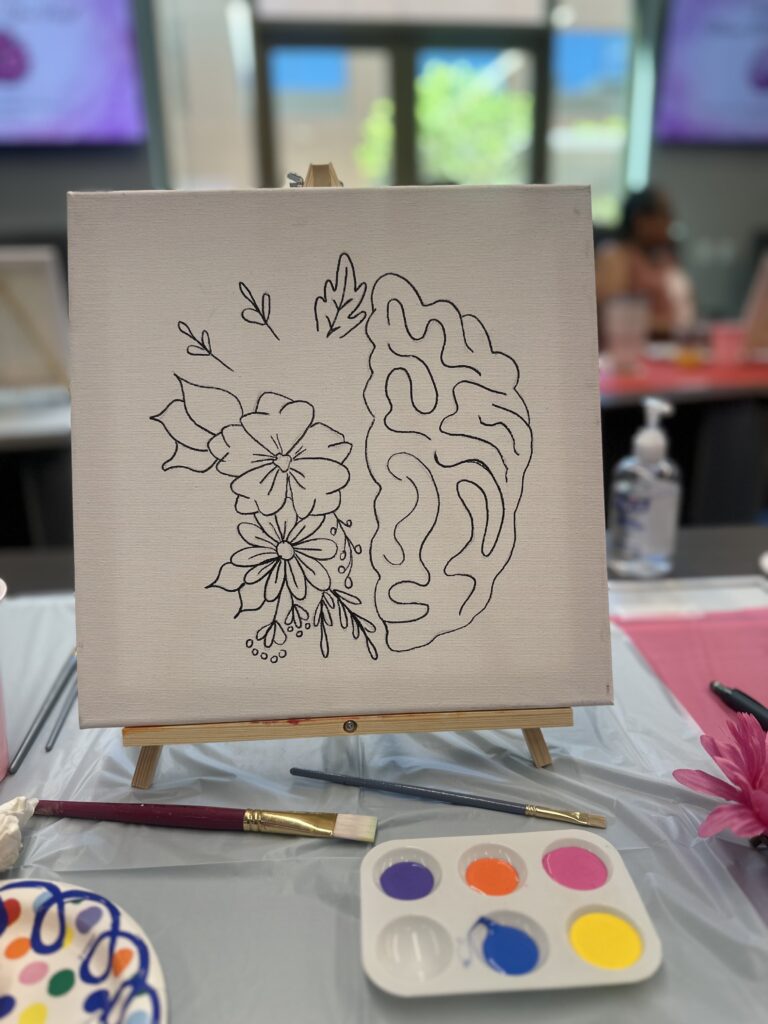
Quiroz’s soothing voice resonates across the room as the group of women sit before a canvas, hand-stitched by a local artist, featuring a brain on one side and flowers on the other. Some of the attendees sip mimosas or juice, nibble on fruit and cheese, and dip their paint brushes into hues of blues, purples, pinks, reds, and yellows.
“You don’t have to have the right words. You don’t have to truly feel healed,” Quiroz says gently. “You just have to show up. This is a space for exploration, creativity, and connection. There is no judgment here, only expressions and compassion for each other. There is no rush–only reflection. You are not alone, and you are healing.”
Barriers to healing in our communities
When it comes to mental health and healing, Quiroz understands that the roadblocks to care facing our communities are cultural, economical, and racial.
According to the U.S. Department of Health and Human Services, Office of Minority Health, Hispanic adults received mental health treatment at a rate that was 28% lower than the total U.S. population.
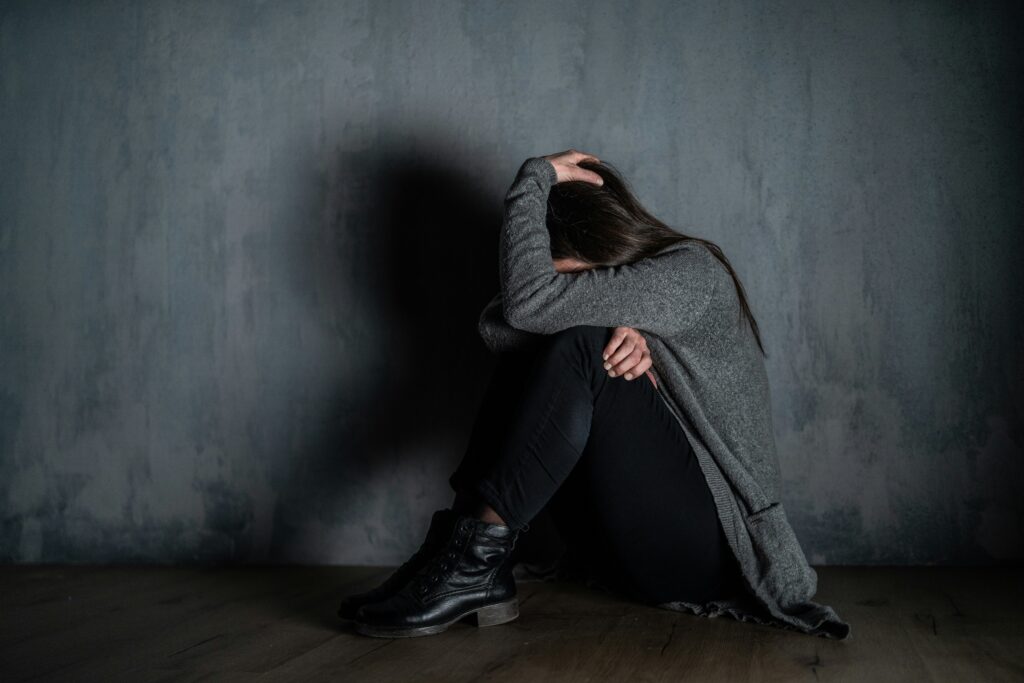
While rates of serious psychological distress are slightly lower (5%) among Hispanic adults, suicide became the fifth-leading cause of death by 2020 for Hispanic/Latino/Latinx individuals (National Library of Medicine).
In our cultura, many are taught to “aguántate”—just suck it up. Seeking therapy is often framed as weakness. Add that to a healthcare system where people of color are more likely to be dismissed, misdiagnosed, or lack coverage, and the mistrust grows deeper.
Psychology meets cultura
As paintbrushes swish across the canvases, Quiroz acknowledges the mistrust many in our communities feel toward mental health services. To bridge that gap, she introduces the principles of positive psychology:
- Resilience
- Gratitude
- Meaning
- Inner strength
- Joy amidst pain
Her approach draws on Martin Seligman’s PERMA model (Positive emotions, Engagement, Relationships, Meaning, Accomplishments).
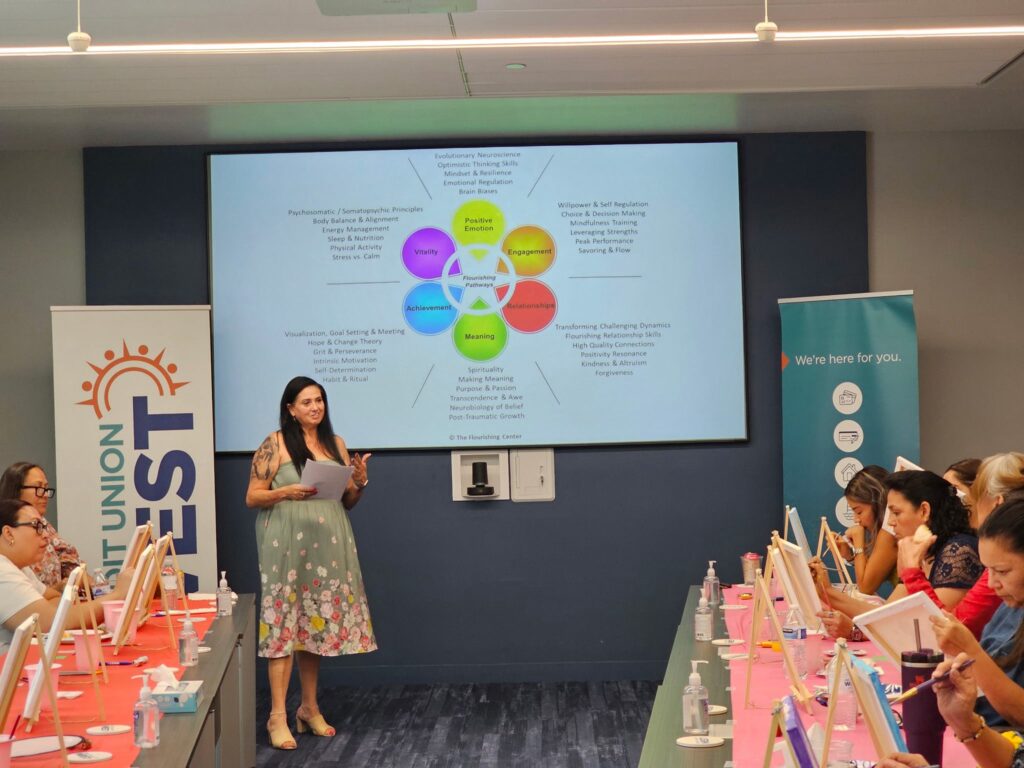
But Quiroz knows not everyone connects with jargon or academic language. So she grounds the theories in her own lived experience—stories the group can recognize in themselves. It’s through these stories that she reveals how deeply personal her commitment to this work truly is, having witnessed firsthand the painful gaps in mental health care for our gente.
A personal story of survival
When Quiroz lost her mother–a community activist who inspired B.L.O.S.S.O.M.S., she was overwhelmed by grief. Despite her training, she found herself on a mountain top with a gun in her hand–ready to end the unrelenting pain found in loss.
But then, the part of her that knew better held on. Quiroz realized she needed help–a support group to help process her grief. When she sought help, however, she was involuntarily institutionalized–a too-common experience for people of color.
A 2022 Psychiatric Services study confirmed this disparity, concluding that structural inequities and bias in decision making contribute to the higher rates of institutionalization.
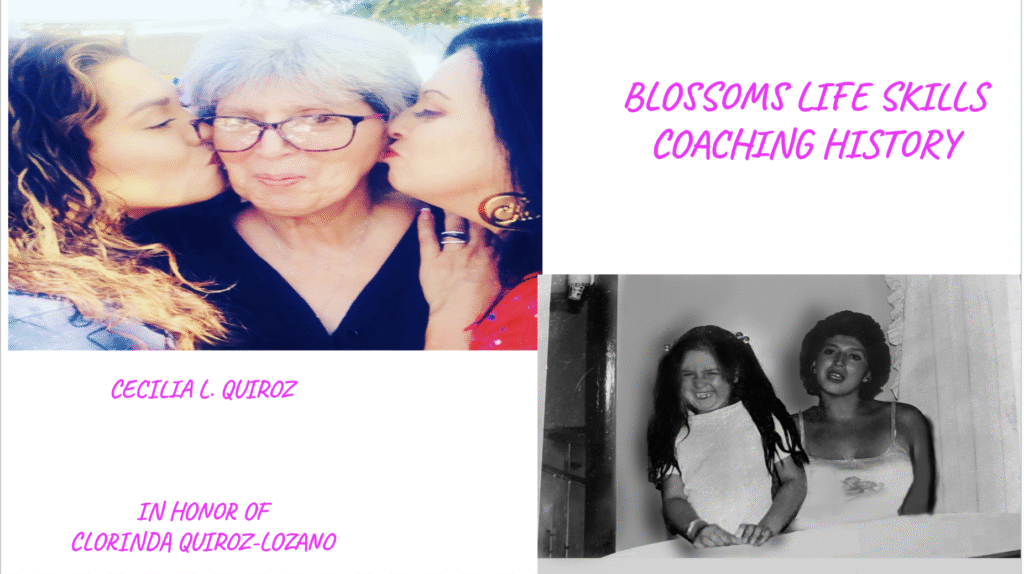
“We know within our community that we are fearful to go out. And that’s rooted in our historical trauma,” Quiroz says.
After her own personal experience, Quiroz knew she needed to do something to fill in the gap. So she uses her mother’s example and meets people where they’re at–to help them overcome their fears.
“My mom always showed up in neighborhoods and homes–communities where transportation was a barrier. She believed in meeting people where they were, literally and emotionally. She was bold, compassionate, and tireless. Everything I do through B.L.O.S.S.O.M.S. comes through her spirit.”
Healing through creativity and connection
In Quiroz’s workshops, art becomes medicine. Painting becomes storytelling.
“As you’re creating, you’re healing. You’re painting as you’re processing. Your story matters. You don’t need to be perfect to bloom. You just need light, space, and someone who cares.”
Quiroz goes on to explain that positive psychology is a science-based approach that focuses on what makes life worth living. It helps us explore joy, gratitude, strength, and meaning–even alongside our struggles.
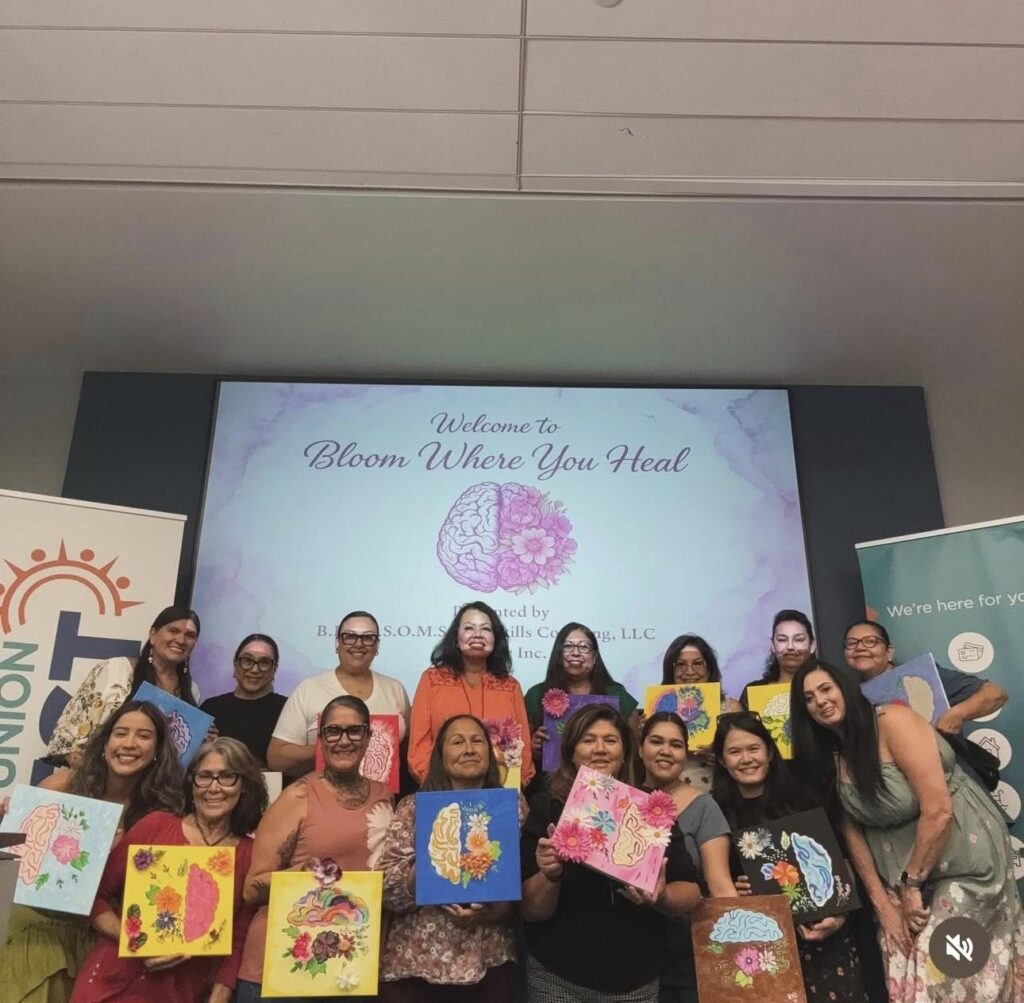
Resilience is a big element of this approach, and what better symbol for a painting topper than a flower–a representation of life and renewal?
But the power is in the finale–when women of different ages and experiences find common ground. They learn they know the same people, share a common job title, lost loved ones to COVID-19 or cancer, divorced recently, or relocated to the Valley and needed connection.
No matter the reason, the attendees all found solace and comfort. They wrap up the event with hugs and pictures. And they leave reminded that healing is possible; it’s not a linear process; and they’re not alone.
Carrying the work forward
Through B.L.O.S.S.O.M.S., Quiroz is helping Chicanos, Latinos, and Latinx individuals find healing in culturally grounded ways. Additionally, as vice president of nonprofit organization Mujer, Inc., she joins other powerful Chicanas and Latinas to help our young women find their purpose, strengthen their foundations, and lead with resilience.
If you’re ready to experience the next B.L.O.S.S.O.M.S. event, the next workshop will be quite the celebration.
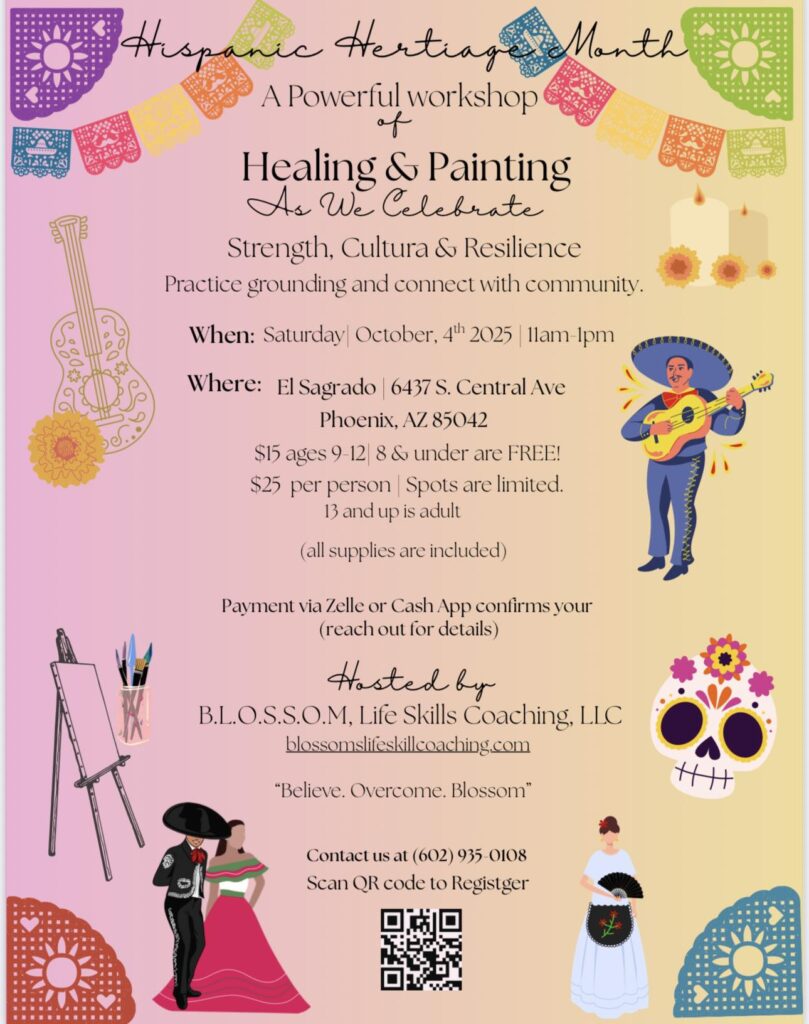
Register now—spots are limited. Donations have been made for those struggling for funding, so if you can’t afford the fee, no worries! Quiroz says finances will never keep her from helping our gente. The fee simply helps pay for the art supplies and workshop treats.
“Healing is for everyone,” she says. “I’d rather you be here–regardless of finances.”